
Best Wholesale Distribution Software for 2026
Discover key features and top picks for wholesale distribution software in 2026 to streamline operations and adapt to a rapidly evolving market.
Read More
Food logistics is an exciting and vast field that includes everyone from large manufacturers and wholesalers to local cafes and family restaurants.
If you're in the business of delivering food you're in a race against time itself. It's crucial to have strong teams, solid networks of suppliers, and excellent technology to stay competitive.
This here is a guide to food logistics for delivery businesses, both B2C home deliveries and B2B wholesale logistics. Keep reading to nail all of your time-sensitive food deliveries.
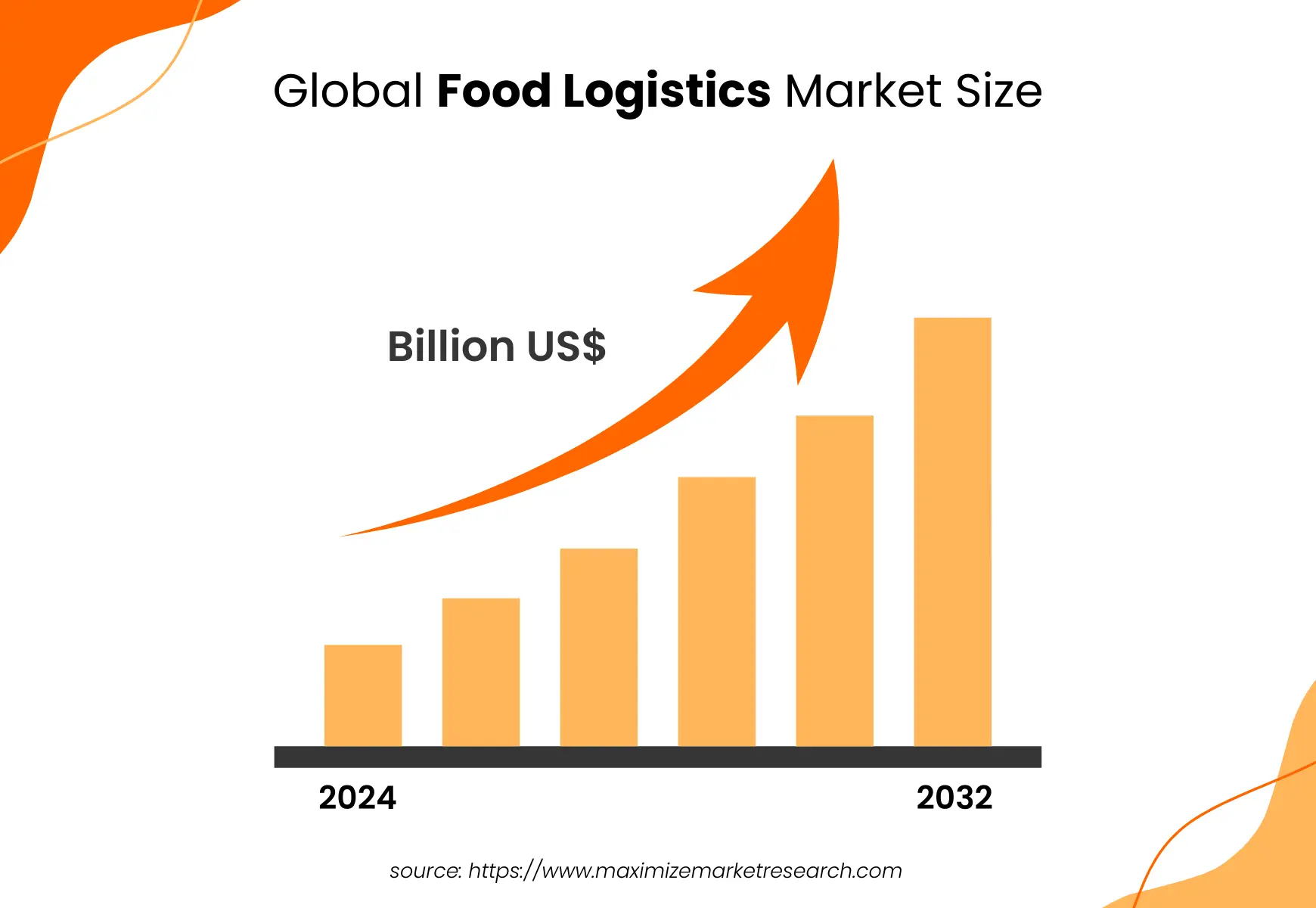
According to the most modest projections, the global food delivery market will reach $211.9 billion by 2032 (growing at a CAGR of 6.9%).
Food logistics involves organizing and managing how food gets from places like farms or factories to where it’s needed, whether to your home (directly to you as a consumer) or a business.
Professionals in this field often have specialized training, such as an MBA in Logistics or Supply Chain Management, and many further enhance their expertise through an online supply chain management course from AIB to better manage the complexity of food transportation, safety, and coordination.
There are B2C food delivery businesses (business to customer) and B2B food delivery businesses (business to business).
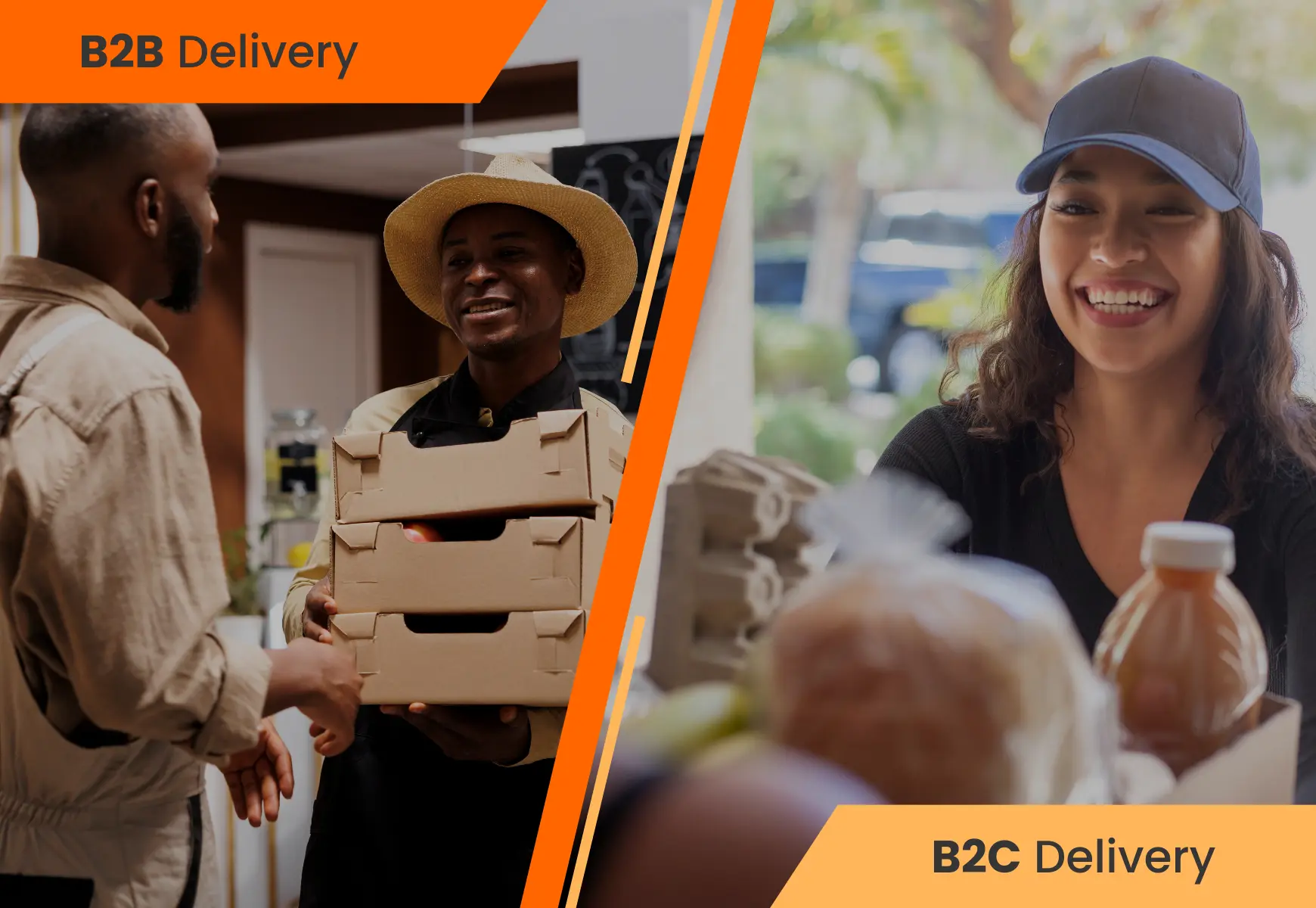
B2C logistics is concerned with last-mile delivery, i.e. transportation of products to the customer's doorstep, including live tracking and Proof of Delivery (POD) as part of the customer experience.
The market of last-mile delivery technology is booming together with the ever-rising demand from consumers, which means it's getting increasingly harder for delivery companies to provide excellent customer experience.
Third-party logistics (3PL) partners like Uber Eats is a popular choice for many food businesses that don't have in-house delivery operations. For instance, understanding the logistics of specialized meal plans like a keto meal delivery service can be key to seizing this new market niche.
However, the Uber Eats lesson is that sometimes, having an in-house delivery team of 1-2 people can help you achieve more, as long as you can organize prescheduled deliveries.
If you're a company that would like to use transportation technology to provide top-quality delivery services, keep reading.
B2B food delivery refers to wholesale transportation. Manufacturers work with distributors who then bring products to personal and professional kitchens.
In a restaurant supply chain or in the ghost kitchen business, you deal with multiple shippers who bring perishable goods to you round the clock. This urgency raises the stakes because any mistakes result in lost money and damaged supplier relationships.
B2B food delivery is a big part of HoReCa logistics, i.e. hotel, restaurant, and café transportation. In many ways, the requirements for B2B food delivery are similar to those in B2C food logistics, e.g. paperless and/or contactless POD, real-time tracking, etc.
In addition to that, B2B food logistics demand more sophisticated solutions for data security and efficiency of supplier ops. For example, a supplier portal allows shippers to log in to add and manage their own orders while using your fleet to organize deliveries without involving your sales team.
The companies mentioned below are well-known for their efficient and extensive food logistics operations. The big players in this industry are:
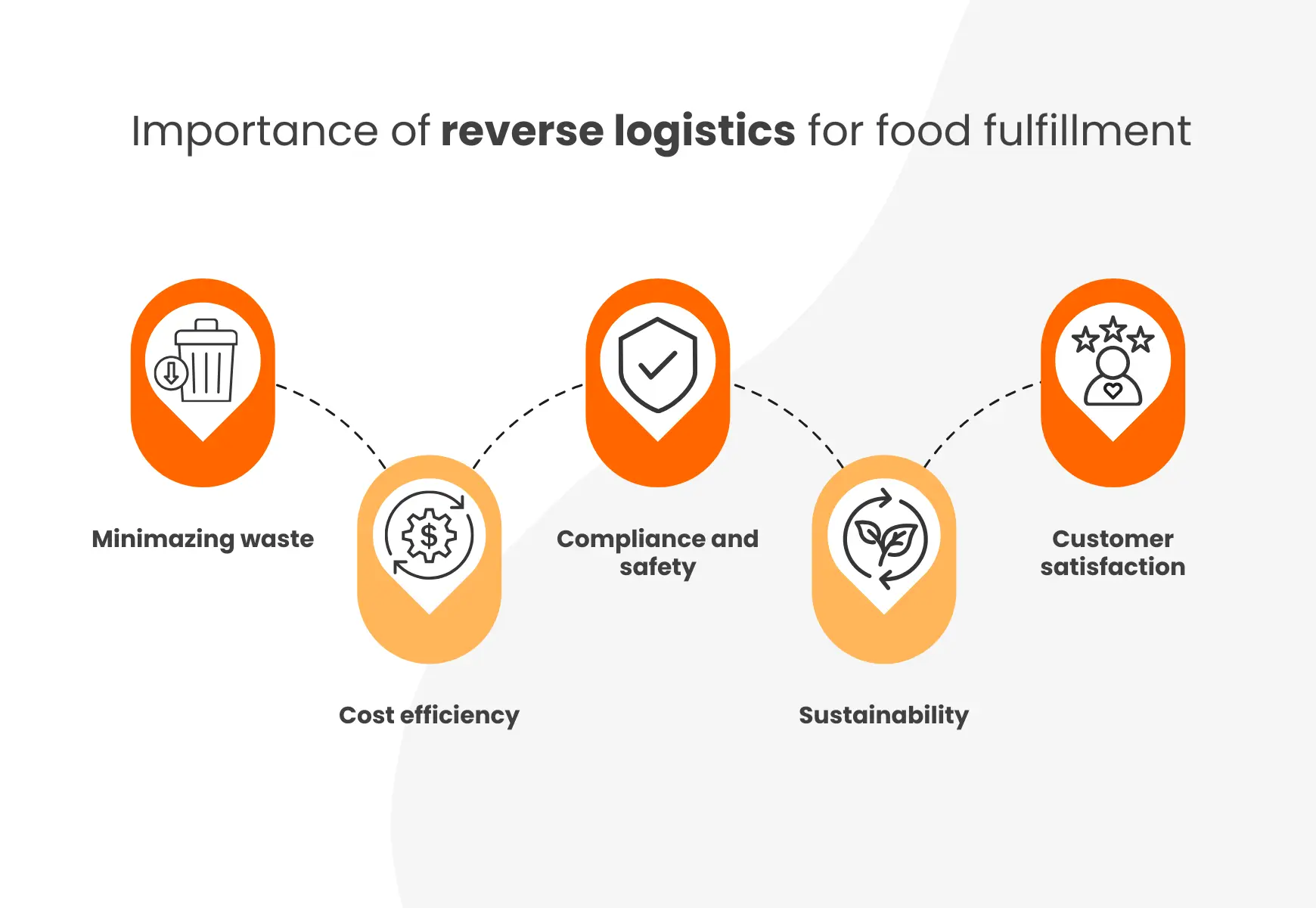
Reverse logistics is important for food fulfillment for several reasons:
Customer satisfaction: Good reverse logistics makes sure returns and replacements are sorted out quickly, which keeps customers happy and loyal.
To handle logistics for B2B food delivery, you should be aware of the KEY STEPS we mention below.
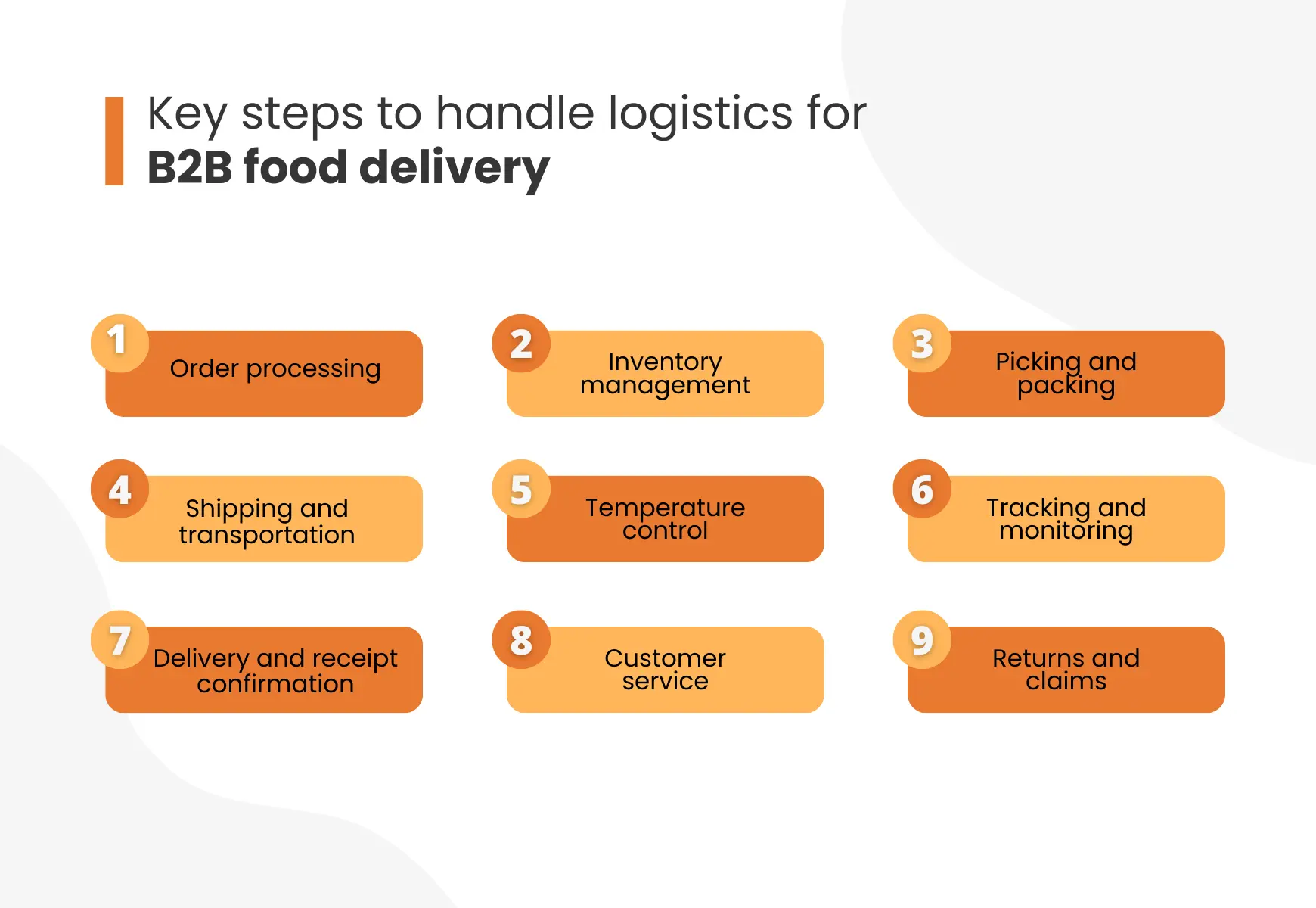
Receive and confirm orders from B2B customers promptly to ensure accuracy in order details and specifications. Using Track-POD's customer portal for shippers helps you speed up order processing by delegating part of order fulfillment to your suppliers.
Keep track of your inventory in real-time to manage stock levels well and avoid running out of products or having too much.
Efficiently pick products from inventory, carefully pack them according to order specifications, and label packages clearly for easy identification. Track-POD's shipping label generator helps you avoid loading mistakes and costly returns.
Choose appropriate shipping methods based on delivery timelines and customer requirements. Obtain detailed instructions from all partners so you can pass them on to your delivery drivers. This way, you avoid delays.
Implement proper temperature controls, especially for perishable food items, to maintain quality and safety throughout transit. Track-POD's vehicle check app helps you keep tabs on all refrigerated vehicles.
Utilize tracking systems to monitor shipments in real-time and provide customers with shipment tracking information for transparency.
Coordinate delivery schedules with customers to ensure someone can receive the confirmed shipment delivery and obtain proof of delivery where necessary.
Maintain open communication channels with B2B customers and address any delivery issues or concerns promptly and professionally. Employ AI agents, tools like Zendesk or XBert by Nextiva to hold the first line on those channels: routine questions about a delivery are answered on the spot, and anything that needs a person moves to the account owner with the full transcript and context attached.
You should establish clear policies and procedures for handling returns, damages, or discrepancies. With this, you’ll be able to process returns efficiently and resolve claims swiftly to maintain customer trust.
Before we begin explaining the steps of handling logistics for B2C food delivery, let’s pinpoint the main difference between B2B and B2C food delivery.
The main differences between these two lies in the following;
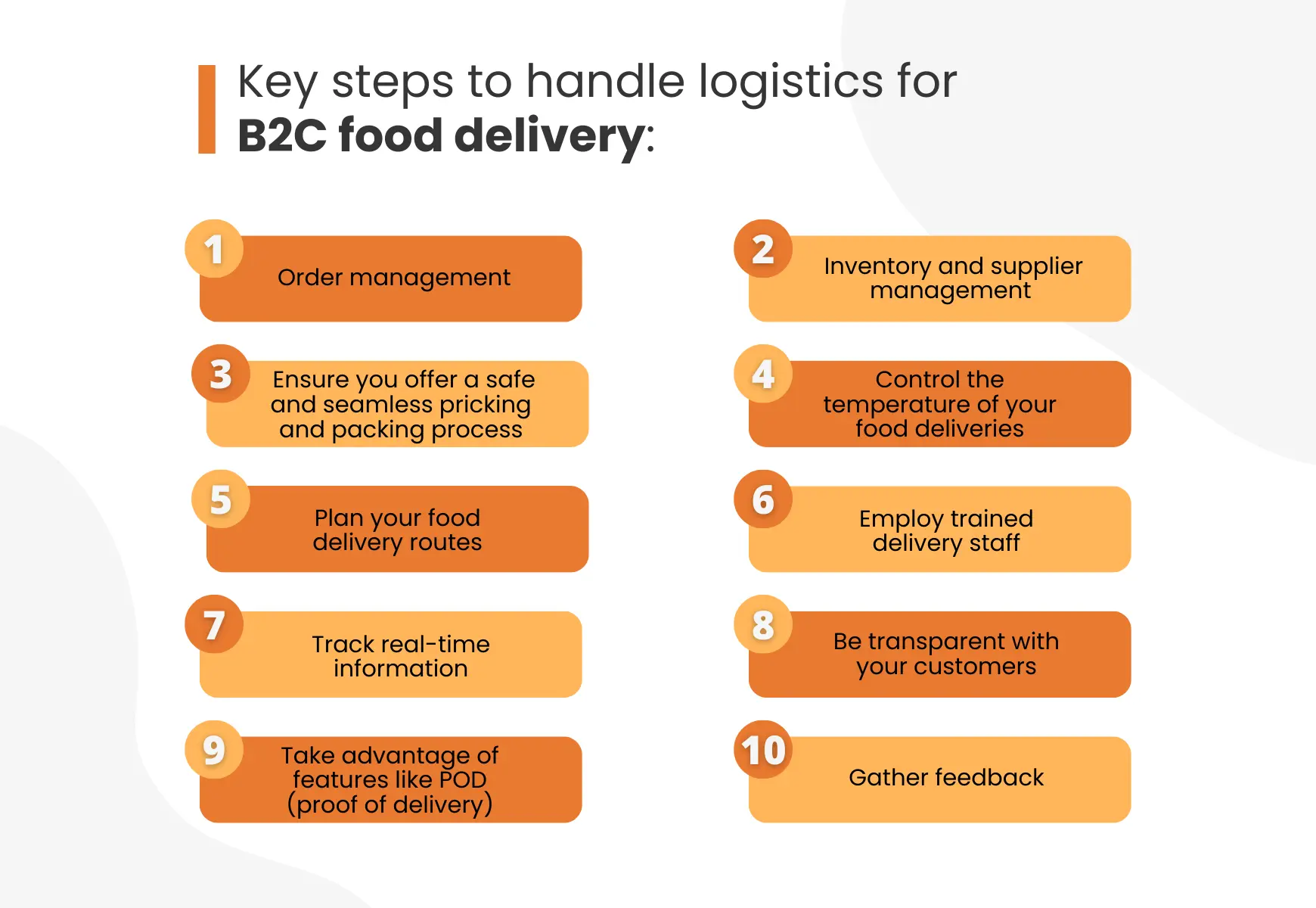
And now the steps for handling B2C (business-to-consumer) food delivery:
Step 1: Order management - Receive orders from individual consumers through your online platform or app. Ensure order accuracy and confirmations are promptly sent to customers.
Step 2: Inventory & supplier management - Keep enough food and ingredients on hand and work with suppliers to ensure they get everything on time and of good quality.
Step 3: Ensure you offer a safe and seamless picking & packing process - Select the right items from inventory quickly, making sure you get the amounts and products correct. Pack everything up securely, using packaging that keeps things fresh and intact.
Step 4: Control the temperature of your food deliveries - Implement strict temperature controls, especially for perishable items, throughout the logistics chain - from storage to transportation and delivery.
Step 5: Plan your food delivery routes - Route planning is about optimizing delivery routes, eventually minimizing travel time. All of this will maximize efficiency, and you can do that by using route planning software solutions to plan for routes for your deliveries, while ensuring operational data is securely managed through cross-cloud backup and recovery solutions to maintain system reliability and continuity.
Step 6: Employ trained delivery staff - Deploy reliable delivery personnel or partners who are trained in handling food deliveries. A competency management breakdown by AG5 can help clarify the capabilities required for the role. Ensure they follow hygiene protocols and provide friendly customer service.
Step 7: Track real-time information - Your customers want real-time tracking information to be available to them 24/7 so they can monitor their delivery status. Advanced tools today can send automated proactive notifications about order status updates or delays.
Step 8: Be transparent with your customers - Customers want transparency and clear communication throughout the entire delivery process. Feel free to ask them any questions so you can conduct your delivery tasks promptly and professionally.
Step 9: Take advantage of features like POD (proof of delivery) - After you deliver food orders, ensure you obtain proof of that delivery. This is your safe card to stay credible and ensure the recipient has completed and received the delivery.
Step 10: Gather feedback - Gather customer feedback to improve service quality, logistics efficiency, and overall customer satisfaction. You should encourage customers to speak up and give feedback on your delivery work.
Positive reviews are always good to see on brand websites because they set the professional tone of your services, building trust and credibility among potential customers.
There's a fair share of global food supply chain disruptions related to factors like the economy, the environment, and geopolitics. That noted, as a company offering food and beverage delivery services or thinking about launching one, you are probably thinking about the challenges to be aware of in the food logistics industry.
Below, we unpack the most important ones that have a knock-on effect on the food supply chain and result in aspects like;
And now the challenges…
Inflation raises costs for fuel, packaging, and labor in food delivery logistics, leading to higher prices for customers. This can mess with budgets, cut down on how often deliveries happen, and make companies look for cheaper ways to keep things running smoothly and control costs.
Climate change disrupts food logistics by causing extreme weather, temperature fluctuations, and increased pests. These issues damage crops, spoil perishable goods faster, and create supply chain delays, making it harder and more expensive for consumers to get food from farms.
ESG rules are changing how food gets traded, and people are really annoyed with "shrinkflation," where products get smaller but prices stay the same or go up. Plus, stuff like attacks on ships in the Red Sea mess with supply lines and drive up costs, making food security worse. Companies need to up their risk management game to handle all this.
Temperature control is a food-specific transportation challenge. Nobody likes cold meals unless they're supposed to be served cold. Therefore, the part of the delivery industry not concerned with groceries will always search for ways to deliver meals while they're still.
The most obvious solution to this is on-demand delivery, i.e., which happens shortly after the order has been placed. Another solution can be fleet optimization, a part of route optimization that is concerned with assigning appropriately equipped vehicles to products.
Cost optimization refers to finding new ways to reduce operational costs. Luckily, there are brilliant transportation management systems (TMS) that automate delivery management and help reduce related costs.
Other challenges in food delivery…
Whether you’re just starting in food delivery or you’ve been at it for a while, keeping up with the latest tech food delivery logistics software solutions is key.
Check out our tips and tricks for making food transportation safe and reliable.
Temperature control is the backbone of food logistics, and food delivery companies must keep the food they deliver fresh and safe until it reaches the customer who ordered it. Our tip for this goes to keeping a close eye on using the right refrigeration and freezing options for different types of food.
Good packaging is vital for keeping food safe during transport. Our tip for this is to use:
Materials that guard against physical, chemical, and biological risks ensure food stays safe. This isn't just about quality - it's all about keeping consumers safe.
Keeping transport vehicles clean is essential to prevent foodborne illnesses. This means that you must choose a logistics partner with impeccable high hygiene standards - it is the food we are talking about 🙂
At all times, they should:
Education is crucial in food warehousing and logistics. Train your staff members on food safety practices on how to handle, store and deal with emergency responses.
Without advanced delivery management software like Track-POD, managing your logistics in food delivery from start to finish will be a hassle. You need an automated route planner to rely on. A built-in feature like that can plan delivery routes to process orders in the most efficient, time-saving, fuel-saving, and safest route for your delivery drivers.
An automated tool like this can provide a pre-scheduled delivery calendar to optimize the entire delivery workflow for every food dispatch.
Fleet optimization is all about planning. By this, we refer to planning about vehicle spaces, route planning so drivers don’t take unnecessary routes, etc.
Track-POD, one of the leading delivery management software has also a logistics app for food delivery, allowing drivers to check whether their vehicles are safe on the road, ensuring no downtime affects customer satisfaction and keeping repair costs low.
Live tracking and ETA (estimated arrival time) are a staple in the last mile logistics food delivery field. As a food delivery logistics manager/owner, you must ensure seamless live tracking of drivers. And yes, providing an order ID is not an option here - it might benefit other parts of the supply chain.
Today, sophisticated tools with baked-in features allow customers to check live-delivery progress with the tip of their fingernails. You only need to enable live tracking notifications by email and SMS, and the delivery management system will do the rest.
Electronic signature and photo proof of delivery are the final stages of successful food delivery. When on-site, your driver should be able to collect e-signatures and take photo proof of contactless deliveries. It is important feature also to look for when you are in search of your food delivery logistics software.
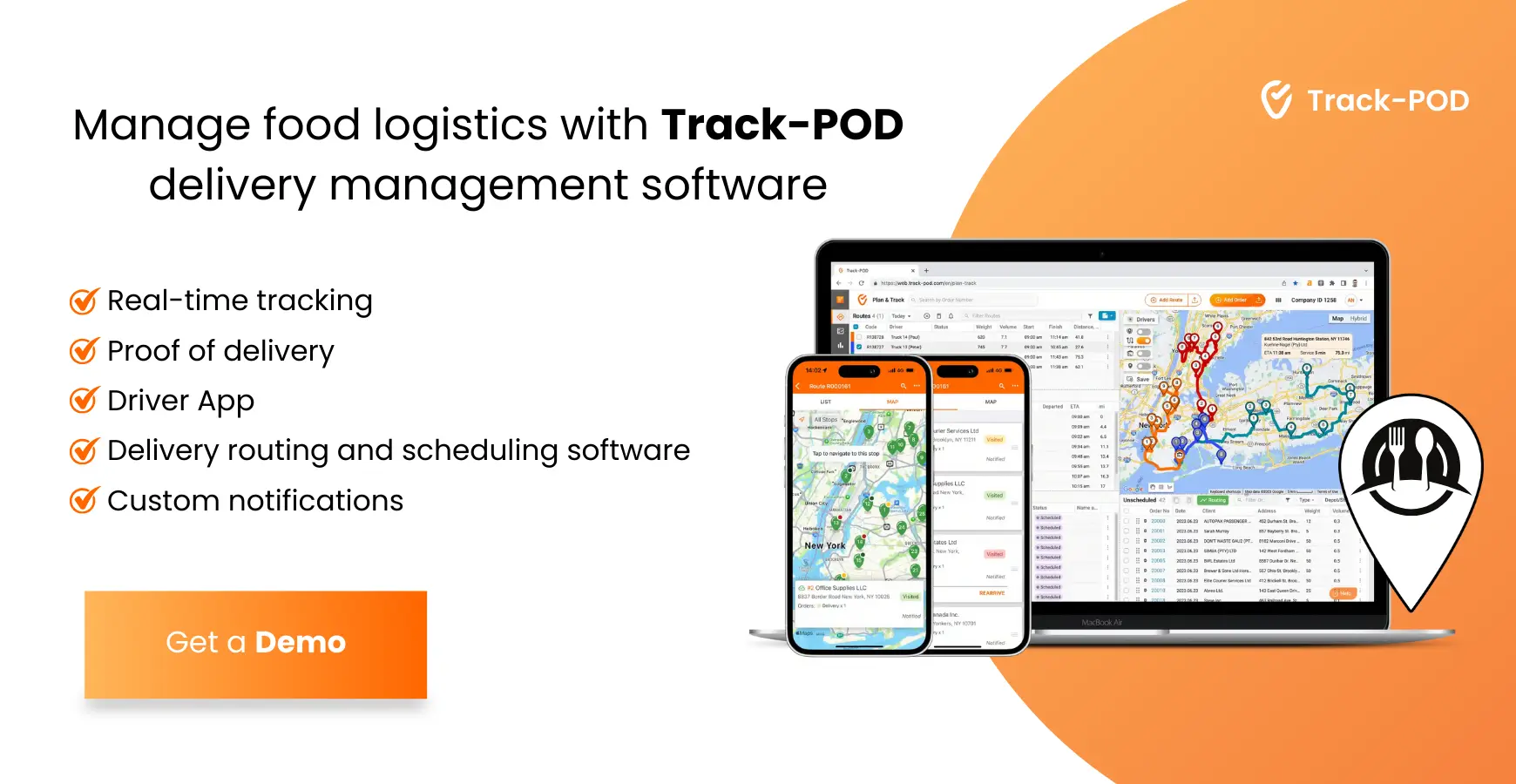
Your transport management system will then store all order information and PODs in the cloud, allowing you to access proof of delivery details and order analytics whenever you want.
This guide breaks down everything you need to know, from B2C (delivering to your doorstep) and B2B (wholesale supply) logistics to top companies that excel in the food logistics delivery industry.
Knowing that the food logistics delivery market is set to hit over 1 trillion by 2027, it’s normal to think that there is a huge business opportunity to embark on - we believe in that, too! However, like with any other business, it is always good to be ahead and know the ins and outs of this industry.
Keeping food fresh is key, so focus on temperature control, smart packaging, and clean transport vehicles.
Also, try to stay ahead and use advanced software tools like Track-POD to help you with real-time tracking, automated route planning, and other management aspects to keep customers happy.
Discover key features and top picks for wholesale distribution software in 2026 to streamline operations and adapt to a rapidly evolving market.
Read More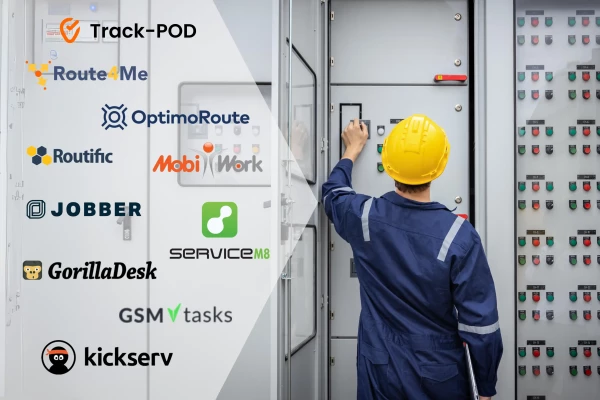
One exciting innovation for companies handling service operations is field service routing software. Discover the top 11 software choices for your business, designed to streamline your daily field operations.
Read More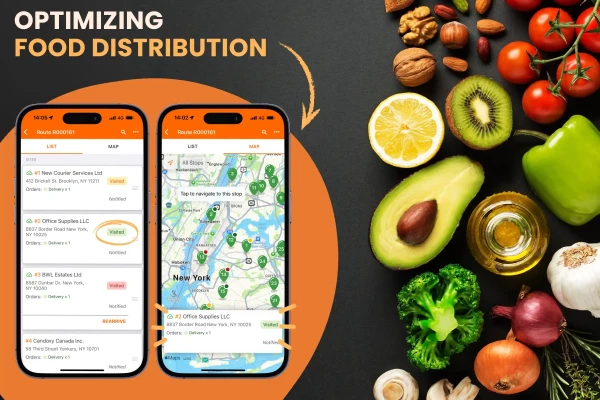
Unlock practical strategies to navigate food warehousing challenges and harness technology for efficient, cost-effective distribution.
Read More